
Channeling the energy of Red Wings’ head coach Todd McLellan, we’re going to get a bit nitpicky today even though the Wings walked away with a 5-1 win last night against the Vancouver Canucks.
Last night marked the 12th time the Wings registered two or fewer shots on goal in the first ten minutes of a game.
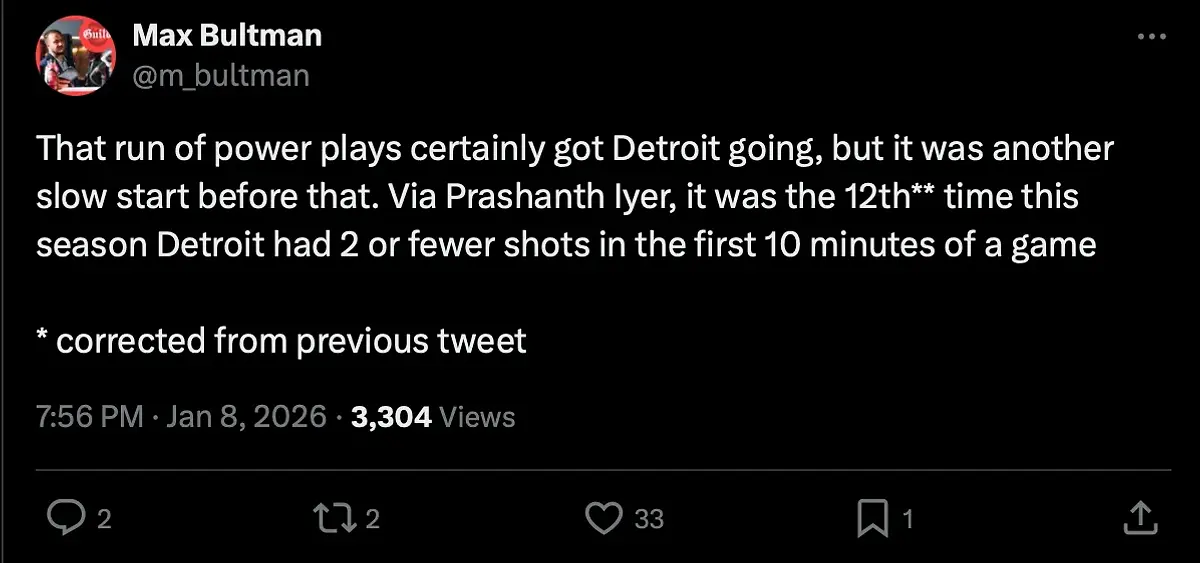
Think about that – in more than a quarter of their games this season, the Wings have recorded less than three shots on goal in the first 10 minutes. That’s worse than a 12 shots on goal pace over a full game and we’re seeing it in more than 25% of Detroit’s games.
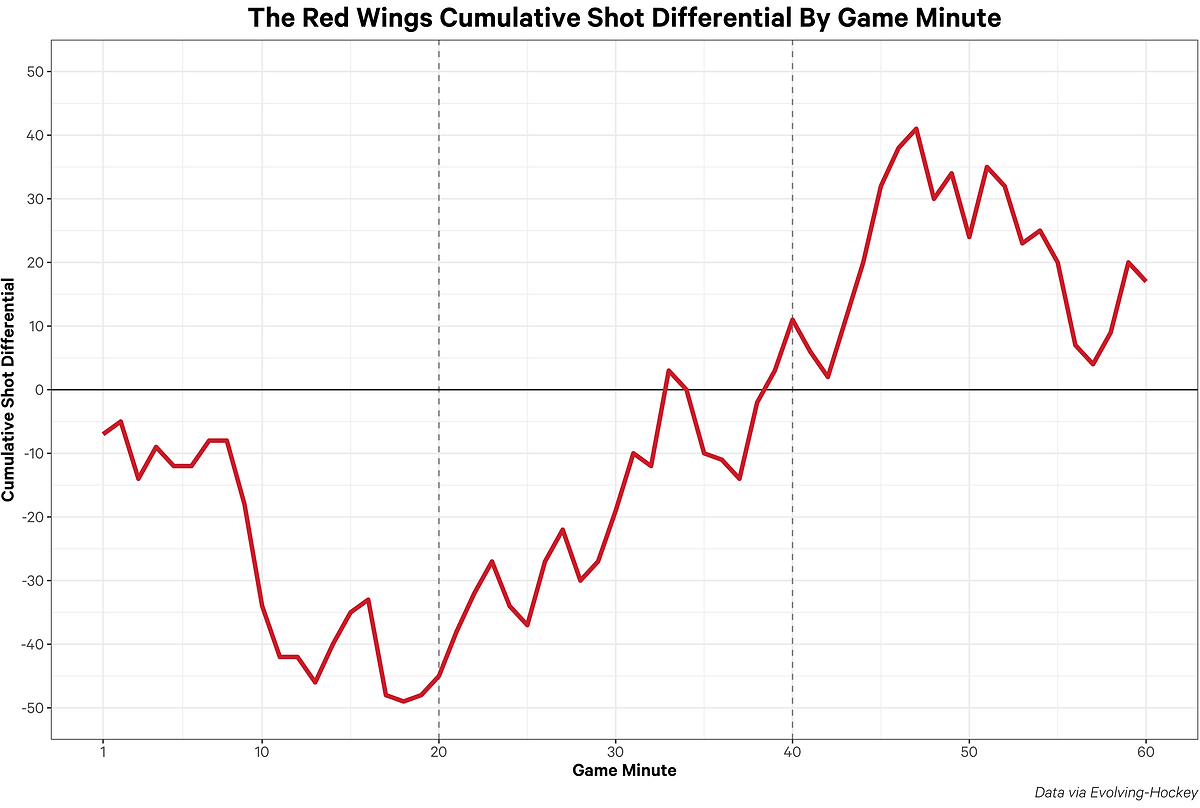
We know that Todd McLellan wants his team to play smart and fast hockey. He wants them to attack off the rush, forecheck aggressively, and be first to loose pucks to generate second chance opportunities. By and large, they’ve done that this season. However, it’s not been a complete 60 minutes with these slow starts. Using data from SportLogiq, we can dive a bit deeper statistically into how the Wings accomplish this and how it takes a bit for them to find their game.
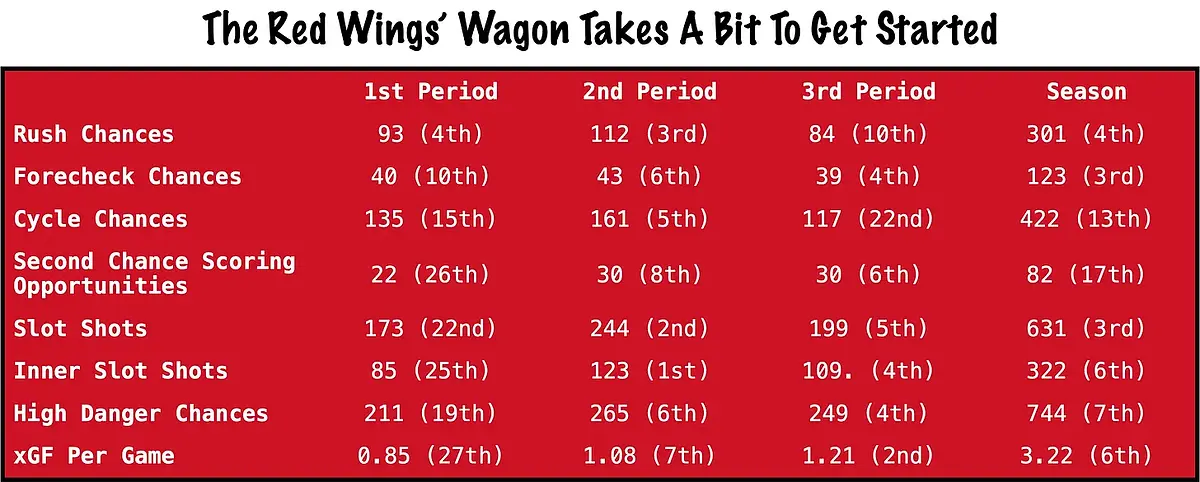
Detroit chances by period — historical article data
Data via SportLogiq. Season totals are copied as printed, not recomputed from the three periods.
| Metric | First period: total (rank) | Second period: total (rank) | Third period: total (rank) | Season: total (rank) |
|---|---|---|---|---|
| Rush chances | 93 (4th) | 112 (3rd) | 84 (10th) | 301 (4th) |
| Forecheck chances | 40 (10th) | 43 (6th) | 39 (4th) | 123 (3rd) |
| Cycle chances | 135 (15th) | 161 (5th) | 117 (22nd) | 422 (13th) |
| Second chance scoring opportunities | 22 (26th) | 30 (8th) | 30 (6th) | 82 (17th) |
| Slot shots | 173 (22nd) | 244 (2nd) | 199 (5th) | 631 (3rd) |
| Inner slot shots | 85 (25th) | 123 (1st) | 109 (4th) | 322 (6th) |
| High danger chances | 211 (19th) | 265 (6th) | 249 (4th) | 744 (7th) |
| Expected goals for per game | 0.85 (27th) | 1.08 (7th) | 1.21 (2nd) | 3.22 (6th) |
From the data above, we can see that in nearly every category, the Wings rank in the bottom half of the league in the 1st period. The Wings struggle to generate dangerous chances and they don’t generate second chance opportunities. What I see from this data is a team that is able to attack off the rush but is not able to forecheck effectively to retrieve pucks for second chances/cycle opportunities and ultimately sustained offensive zone time. Instead, the Wings are a “one shot and done” team off the rush and the opposition is able to transition out of the zone quickly to limit the Wings’ offensive zone possession time. Following the slow 1st periods, the Wings kick it into high gear, taking their offensive game to an elite level. Their resiliency and ability to reclaim control of play should be commended.
To date, these slow starts haven’t significantly impacted the Wings as they sit 4th in the Eastern Conference in points percentage. Despite scoring only 29 goals in the 1st period (3rd worst in the league), the Wings only have a -4 goal differential after 20 minutes. A big reason for that is their goaltending. Per SportLogiq, John Gibson ranks 7th in the league with 9.3 goals saved above expected in the 1st period alone. Together, the Wings’ goalies have posted a .920 save percentage in the 1st period, good for 10th best in the league. Their goalies have been holding down the fort until the offense wakes up.
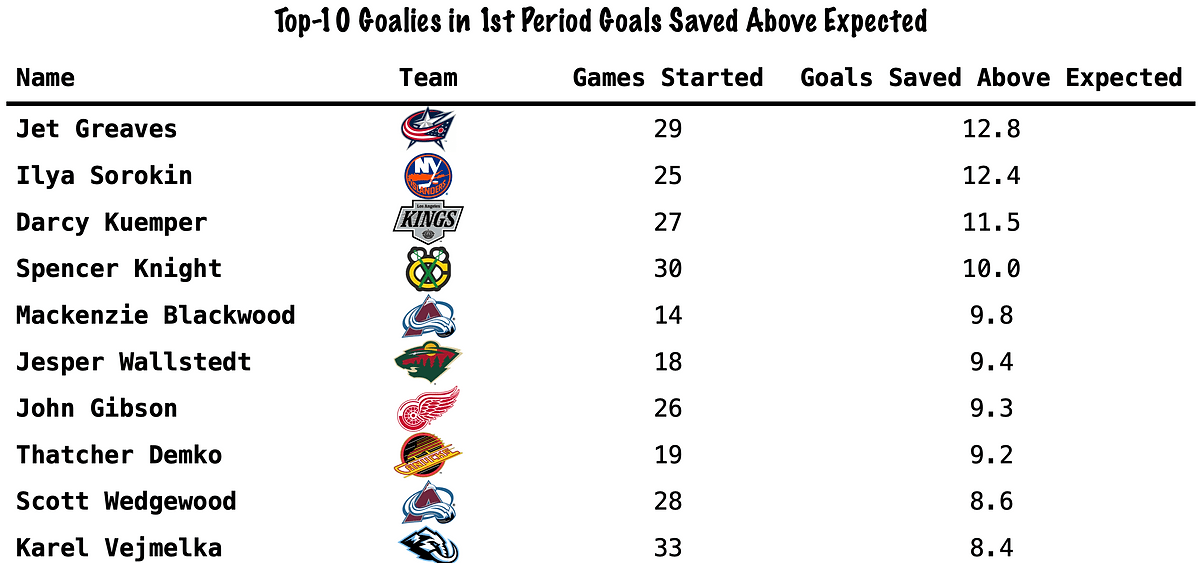
First-period goals saved above expected — historical article data
Data via SportLogiq. Team names transcribe the logos in the source graphic.
| Goalie | Team shown | Games started | Goals saved above expected |
|---|---|---|---|
| Jet Greaves | Columbus Blue Jackets | 29 | 12.8 |
| Ilya Sorokin | New York Islanders | 25 | 12.4 |
| Darcy Kuemper | Los Angeles Kings | 27 | 11.5 |
| Spencer Knight | Chicago Blackhawks | 30 | 10.0 |
| Mackenzie Blackwood | Colorado Avalanche | 14 | 9.8 |
| Jesper Wallstedt | Minnesota Wild | 18 | 9.4 |
| John Gibson | Detroit Red Wings | 26 | 9.3 |
| Thatcher Demko | Vancouver Canucks | 19 | 9.2 |
| Scott Wedgewood | Colorado Avalanche | 28 | 8.6 |
| Karel Vejmelka | Utah Mammoth | 33 | 8.4 |
Larry Murphy mentioned this on the broadcast last night but when a team scores first, it gives them some confidence to stick with their intended gameplan and allows them to play their game. When teams get down on the scoreboard, they have to take more chances, the neutral zone opens up, and often it becomes a game of alternating chances. Despite all their offensive struggles, the Wings have still managed to score first in nearly half their games played (22 times) which lets them stick with their gameplan for the most part. And even when the Wings do yield the 1st goal, their goalies do an excellent job of preventing them from going down 2-0. In the 23 games where the Wings have yielded the 1st goal, they have only given up the next goal eight times.
To borrow a quote from Patrick Kane, this is a good hockey team. However, there are still some areas that can be cleaned up, most notably their slow starts. Right now, the Wings’ goalies are keeping the team in the game until the offense gets going, but that’s not exactly a strategy that Todd McLellan will want to utilize as this team makes a push for its first playoff berth in a decade. Let’s see if Todd and the leadership group can find a way to get this team ready to go from puck drop.